In short
- The road to Emmaus (Luke 24:13–35) tells how the risen Jesus walked unrecognized with two disciples, explained the Scriptures to them, and was known when he broke bread.
- Only one of the two travellers is named: Cleopas. Luke leaves the other anonymous, and later traditions have suggested Luke himself or a member of Cleopas's family.
- Nobody knows for certain where Emmaus was. Most manuscripts put it 60 stadia (about 11 km or 7 miles) from Jerusalem, some read 160 stadia, and at least four sites have been proposed.
- Catholics and Orthodox Christians hear in the breaking of the bread the shape of the Eucharist; many Protestants stress the opened Scriptures and the thanksgiving at an ordinary table.
- For daily reading, the story suggests four habits: bring your real questions, read the whole Bible as one story, stay a little longer in prayer, and carry what you heard to someone else.
The road to Emmaus is the account in Luke 24:13–35 of the risen Jesus walking with two discouraged disciples on the day of his resurrection. They do not recognize him. He explains the Scriptures to them as they walk, and they know him at last when he breaks bread at their table.
It is one of the longest resurrection stories in the Gospels, and Luke is the only evangelist who tells it in full. It is also a story about reading: about what happens when the Bible is opened by someone who knows where it leads.
What happens on the road to Emmaus?
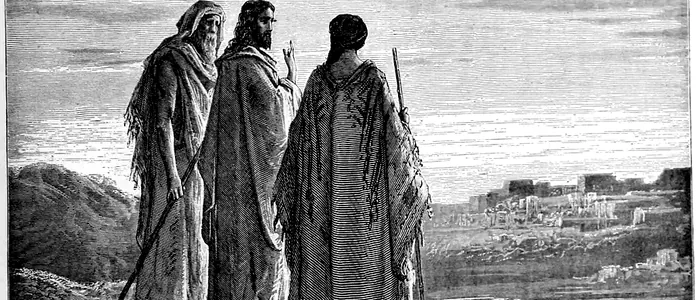
It is the afternoon of the first Easter Sunday. Two followers of Jesus are leaving Jerusalem for a village called Emmaus, talking over the arrest, the cross, and the strange report from the women who found the tomb empty.
13Behold, two of them were going that very day to a village named Emmaus, which was sixty stadia from Jerusalem. 14They talked with each other about all of these things which had happened. 15While they talked and questioned together, Jesus himself came near, and went with them. 16But their eyes were kept from recognizing him.
The stranger asks what they are discussing, and they stop, downcast (Luke 24:17). Cleopas tells him everything: Jesus of Nazareth was a prophet powerful in word and deed, the leaders handed him over to be crucified, and it is now the third day. Then comes one of the saddest lines in the Gospel. They had hoped he was the one who would redeem Israel (Luke 24:21). The hope is in the past tense.
The stranger answers with a rebuke and then a long lesson from the Scriptures. When they reach the village he makes as if to go on, and they press him to stay because evening is near (Luke 24:28–29). At the table he takes bread, gives thanks, breaks it, and hands it to them. They recognize him, and he vanishes.
They get up that same hour and walk back to Jerusalem in the dark. There they find the eleven already saying that the Lord has risen and has appeared to Simon, and they tell what happened on the way and how he was known to them in the breaking of the bread (Luke 24:33–35).
Who were Cleopas and the other disciple?
Cleopas is named once, in Luke 24:18, and nowhere else in the New Testament under that spelling. He was a disciple of Jesus but not one of the twelve; the story itself has the two travellers return to find the eleven gathered without them.
An early tradition identifies him with Clopas, whose wife or relative Mary stood near the cross (John 19:25). The second-century writer Hegesippus, quoted by Eusebius in his Church History, says Clopas was a brother of Joseph. If the two names belong to one man, Cleopas was part of Jesus's wider family. That link is old and widely held, but it is a tradition and not something Luke states.
Luke never names the second traveller. Suggestions have not been lacking:
- Luke himself. Orthodox hymns sung with this Gospel at Sunday Matins name Luke as Cleopas's companion.
- A member of Cleopas's household. Some modern readers suggest his wife, pointing to the Mary of John 19:25, since the two seem to share a home in Emmaus.
- No one in particular. Many preachers have noticed that an unnamed disciple leaves a place open, and that a reader can walk the road in it.
None of these can be proven. What Luke does tell us is that the two were ordinary followers, not leaders, and that the risen Christ spent most of an afternoon with them.
Where was Emmaus?
No one knows for certain. Emmaus was a village near Jerusalem, and Luke gives its distance from the city, but the manuscripts do not agree on the number and several places have claimed the name.
Most manuscripts of Luke 24:13 read sixty stadia. A stadion was a little under 200 metres, so sixty stadia come to about 11 kilometres, or 7 miles. A smaller group of manuscripts, including the fourth-century Codex Sinaiticus, reads one hundred and sixty stadia, about 30 kilometres. Printed Bibles have followed the sixty-stadia reading since the sixteenth century.
| Proposed site | Distance from Jerusalem | Case for it |
|---|---|---|
| Emmaus Nicopolis (Imwas, also written Amwas) | about 30 km, close to 160 stadia | The oldest tradition. Eusebius and Jerome placed the Gospel Emmaus here. |
| Abu Ghosh, beside the biblical Kiriath-Jearim | somewhat more than 60 stadia | Honoured as Emmaus in the Crusader period; a church from that time still stands. |
| el-Qubeibeh | about 65 stadia | Linked with Emmaus since Crusader times; the Franciscans built a church there in 1902. |
| Motza (ancient Colonia) | about 30 stadia, roughly 6 km | Josephus mentions an Emmaus 30 stadia from the city; proposed in the nineteenth century and again after excavations in 2001–2003. |
Each site has a difficulty. Nicopolis has the earliest witnesses, but a 30-kilometre walk out and another back the same evening is a great deal, though not impossible. The nearer sites fit the sixty stadia better but have later traditions behind them. The 1909 Catholic Encyclopedia concluded that the true site was probably lost by the third century.
The uncertainty does not touch the meaning of the story. Luke's interest is in what happened on the way.
What did Jesus explain from Moses and the prophets?
Before any bread is broken, there is a Bible study on the road, and it begins with a hard word.
25He said to them, “Foolish people, and slow of heart to believe in all that the prophets have spoken! 26Didn’t the Christ have to suffer these things and to enter into his glory?” 27Beginning from Moses and from all the prophets, he explained to them in all the Scriptures the things concerning himself.
Luke does not list the passages. He gives the method. Moses stands for the first five books and the prophets for the rest of what Jews then read as Scripture, and the claim is that all of it, taken together, leads to a Messiah who suffers and then enters his glory.
Notice what the two disciples were missing. They knew the facts of the weekend, and they knew their Scriptures. What they lacked was the thread that tied the two together. The stranger does not give them new information so much as a way of reading what they already had.
Christians of every tradition have taken this as a charter for reading the Old Testament and the New together. John Calvin, commenting on this verse, wrote that Christ is made known through the Gospel only when the Law and the Prophets shed their light on him, and he warned against setting the older books aside. The Catholic and Orthodox liturgies make the same point without argument, by reading the Old Testament, the Psalms, and the Gospel side by side.
In practice this means the Bible rewards being read as one story. Passover in Exodus, the suffering servant in Isaiah, and the Psalms that Jesus prayed are not background to the Gospels; they are part of how the Gospels explain themselves. If you are new to all this and wondering where to begin, a short guide to starting the Bible may help.
What does the breaking of the bread mean?
The turning point comes indoors, at an evening meal.
30When he had sat down at the table with them, he took the bread and gave thanks. Breaking it, he gave it to them. 31Their eyes were opened and they recognized him; then he vanished out of their sight. 32They said to one another, “Weren’t our hearts burning within us while he spoke to us along the way, and while he opened the Scriptures to us?”
Four verbs carry the scene: he took the bread, gave thanks, broke it, gave it. Luke uses almost the same sequence at the Last Supper (Luke 22:19) and at the feeding of the five thousand (Luke 9:16). Readers have always noticed the echo, and they have drawn somewhat different conclusions from it.
The Catholic reading. The Catechism of the Catholic Church lists "the Breaking of Bread" among the names of the Eucharist and says it is by this action that the disciples recognize Jesus after his resurrection (CCC 1329). It also sees in Emmaus the two-part shape of the Mass: on the road he explains the Scriptures, and at the table he takes, blesses, breaks, and gives (CCC 1346–1347). John Paul II opened his 2004 letter for the Year of the Eucharist with the disciples' plea to the stranger to stay with them.
The Orthodox reading. In the Orthodox Church the Emmaus story is one of eleven resurrection Gospels read in rotation at Sunday Matins, so a parish hears it several times each year. The hymns appointed with it keep returning to the two moments Luke joins, the Scriptures opened on the road and Christ known in the breaking of the bread. The Divine Liturgy follows the same order: first the Word, then the Table.
A Protestant emphasis. Calvin knew that Augustine and most interpreters after him took the bread at Emmaus as the sacrament, and he disagreed. He read the scene as Jesus giving thanks in his familiar way over an ordinary meal, a gesture the disciples knew well enough to wake them. Many Protestants follow him and place the weight of the story on the opened Scriptures. Other Protestants are glad to hear an echo of the Lord's Supper. In either case the story honours the plain act of giving thanks before food.
These readings differ on real questions, and it would not be honest to blur them. They share more than they dispute: Christ is recognized where Scripture is opened and bread is shared in thanksgiving.
What does the burning heart mean?
Only after the stranger is gone do the two disciples compare notes, and they find that something had been happening in them for hours (Luke 24:32). Their hearts were burning on the road, while he was speaking, before they knew who he was.
The burning heart is not an emotion they worked up. It is their name, given afterwards, for what it was like to have the Scriptures opened. The verb is the same one Luke uses a verse earlier for their eyes being opened. First the book opens, then the eyes.
Two things follow for ordinary readers. Recognition often comes late, so a morning of reading that felt flat may look different by evening. And the test of a good reading is not how strongly you felt but whether, looking back, the words did some quiet work in you. A short review at the end of the day, such as the evening examen, is one way to notice.
Four things the road teaches about daily Bible reading
The story is not a method, but it does suggest a pattern. Here are four practices drawn from the order of events.
- Bring what you are actually carrying. The first thing Jesus does is ask a question, and the disciples answer with their disappointment in full (Luke 24:17–24). You can begin a reading the same way, by saying plainly what is on your mind today. Scripture tends to open to people who admit what they had hoped for.
- Read toward the whole story. A single verse is a good start. It says more when you see it inside its chapter, and the chapter inside the long story that runs from Moses through the prophets to Christ (Luke 24:27). When you read a Gospel, follow a cross reference back into the Old Testament now and then. When you read the Old Testament, ask where the road is heading.
- Ask him to stay. The stranger would have walked on if they had not pressed him (Luke 24:28–29). Reading turns into prayer at the moment you linger: one line read a second time, a minute of silence, a sentence of thanks. Lectio divina is the classic way of making that lingering a habit.
- Get up and carry it. The two walk back to Jerusalem that same night and tell the others (Luke 24:33–35). A reading is finished when something of it leaves the room with you: a phrase to keep for the day, a person to forgive, a friend to tell.
This walk is also where the Emmaus app takes its name. Its daily ritual follows the same order in miniature, from the Word to reflection to prayer to one thing carried into the day.
If the four steps seem like a lot, begin with the first and the last. Say what you are carrying, read a few verses, and take one phrase with you. A habit that small can last, and building a daily reading habit is mostly a matter of making it small enough to keep.
Questions
What is the main message of the road to Emmaus?
The story in Luke 24:13–35 says that the risen Jesus meets people in their disappointment, that the whole of Scripture points to him, and that he makes himself known in the breaking of the bread. Two disciples leave Jerusalem without hope and return the same night as witnesses. Christians have long read it as a picture of how faith grows: by listening on the way and by recognizing Christ at the table.
Who was Cleopas in the Bible?
Cleopas is one of the two disciples who walk to Emmaus on the day of the resurrection, and the only one Luke names (Luke 24:18). He was not one of the twelve apostles. An old tradition identifies him with Clopas, mentioned in John 19:25, whom the second-century writer Hegesippus calls a brother of Joseph. The Roman Catholic calendar remembers him on 25 September and the Eastern Orthodox on 30 October.
Where is Emmaus today?
The location is uncertain. The four sites most often proposed are Emmaus Nicopolis (the former village of Imwas, about 30 km from Jerusalem), Abu Ghosh, el-Qubeibeh, and Motza, all west or north-west of the city. The oldest Christian tradition favours Nicopolis, which fits the manuscripts that read 160 stadia. The other sites lie closer to the 60 stadia found in most manuscripts. No identification has been proven.
How far is Emmaus from Jerusalem?
Most manuscripts of Luke 24:13 say sixty stadia, which is roughly 11 kilometres or 7 miles, a walk of two to three hours. A smaller group of manuscripts, including Codex Sinaiticus, says 160 stadia, about 30 kilometres. English Bibles follow the sixty-stadia reading and usually print about seven miles. The difference matters mostly for deciding which ancient village Luke had in mind.
Why did the disciples not recognize Jesus on the road to Emmaus?
Luke does not say they failed to look closely. He says their eyes were kept from recognizing him (Luke 24:16), and later that their eyes were opened (Luke 24:31). The wording suggests that recognition was given rather than achieved. In the story it comes only after they have heard the Scriptures explained and after the bread is broken, so that they learn where to look for him once he is no longer visible.
Is the breaking of bread at Emmaus the Eucharist?
Christian traditions answer differently. The Catechism of the Catholic Church points to this scene when it explains the name Breaking of Bread and the two-part shape of the Mass, and Orthodox hymns for the Emmaus Gospel dwell on the same moment. John Calvin, by contrast, read it as Jesus giving thanks in his usual way at an ordinary meal. All agree that Luke links recognizing Christ with Scripture and with a shared table.
Sources
- Catechism of the Catholic Church, 1328–1332 (the names of the sacrament, including the Breaking of Bread)
- Catechism of the Catholic Church, 1345–1347 (the structure of the Mass and the Emmaus meal)
- John Paul II, Apostolic Letter Mane Nobiscum Domine (7 October 2004)
- John Calvin, Commentary on a Harmony of the Evangelists, on Luke 24:13–30 (CCEL)
- Exaposteilarion and Doxastikon of the Fifth Eothinon, the Emmaus Gospel at Orthodox Sunday Matins
- Eusebius, Church History, Book III, chapter 11 (Hegesippus on Clopas), New Advent
- S. Vailhé, "Emmaus", Catholic Encyclopedia (1909), New Advent
- "Emmaus", Wikipedia (manuscript readings and proposed sites, with references)
- "Cleopas", Wikipedia (traditions and feast days, with references)